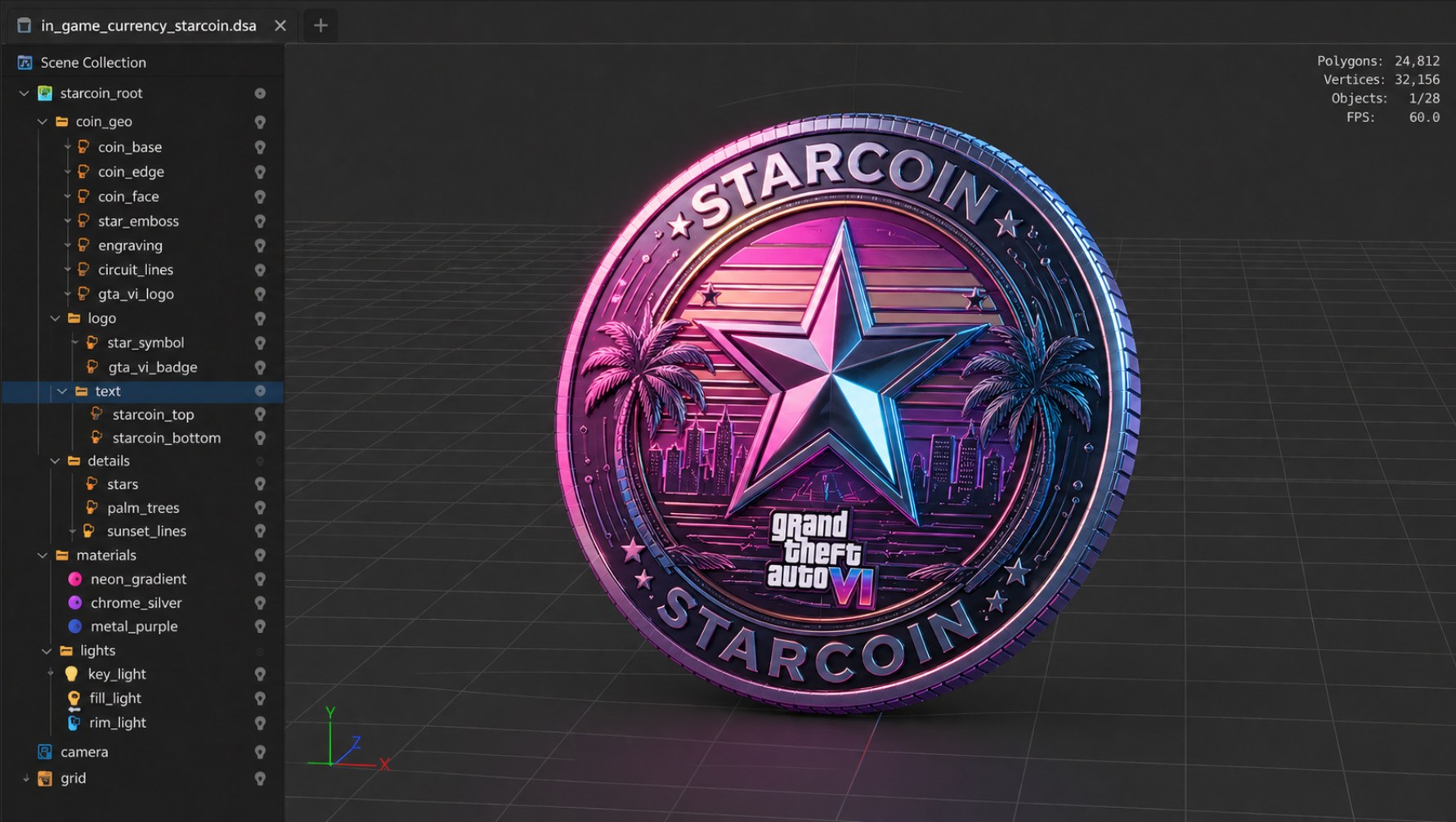
A pseudonymous leaker posting under the handle @palm_uberhacker dropped a single screenshot to X late Monday night that has sent both the gaming and crypto press into a low-grade frenzy. The image, which the account claims was pulled from an internal Rockstar Games asset-pipeline workstation, shows a 3D-modeling viewport rendering a circular coin asset stamped STAR COIN across its top arc and STAR COIN again along the bottom, with a stylized star, a Vice-City-style palm-tree skyline, and a clearly legible GRAND THEFT AUTO VI badge embossed across the coin's face. The viewport's tab title reads in_game_currency_starcoin.dsa. The polygon counter in the top-right shows 24,812 polygons, 32,156 vertices, 1/28 objects selected, FPS pinned at 60.0. The scene tree on the left names the asset starcoin_root and breaks it down into a coin_geo mesh group, a logo group containing both star_symbol and gta_vi_badge children, and a materials folder with neon_gradient, chrome_silver, and metal_purple shaders. It is, in short, exactly the kind of granular technical screenshot that is either an authentic leak from inside a content-production pipeline or an extraordinarily well-prepared fake.
Take-Two Interactive, Rockstar's parent, did not respond to requests for comment by the time of publication. A spokesperson for the publisher's external PR firm acknowledged the inquiry and said only that the company "does not comment on rumors, speculation, or unverified materials." Rockstar's official channels have not posted since the leak surfaced. The pattern is consistent with the publisher's posture during the 2022 GTA VI development-footage leak, in which an attacker posting under the handle teapotuberhacker released roughly 90 video clips of pre-alpha gameplay and Take-Two declined to characterize the material on the record for nearly a week. The 2022 incident was eventually attributed to a 17-year-old member of the Lapsus$ collective and resulted in a London court conviction. The handle conventions and the operational tone of the new @palm_uberhacker account are obviously and deliberately echoing that lineage.
The substantive question for crypto-industry readers is whether "Star Coin" is, in any technical sense, a cryptocurrency in the on-chain meaning of the word, or whether it is a closed-loop in-game token of the GTA Online "Shark Cards" lineage that has been given crypto-aesthetic branding because the marketing surface has shifted. The leaker's two follow-up posts, both of which were screen-captured and reposted before the original account locked itself, claimed without evidence that Star Coin is "settled on a permissioned ledger run by Rockstar with off-ramps via partner exchanges in selected jurisdictions." That description, if accurate, would put the asset in the same category as Roblox's Robux or Epic's V-Bucks operationally, with a thin blockchain-settlement layer bolted on the back end primarily for accounting and audit purposes rather than for genuine user-side composability. Several engineers at major crypto-gaming infrastructure providers — speaking on background, because none of them have been briefed by Take-Two — said the permissioned-ledger framing is consistent with what they would expect a publisher of Rockstar's scale to ship if it wanted the cosmetic upside of crypto without the regulatory exposure of an open token.
The regulatory exposure is, in fact, the central reason most crypto-industry observers are skeptical of an open-token launch. The U.S. Federal Trade Commission's 2024 settlement with Epic Games over loot-box practices, the United Kingdom's Online Safety Act provisions on virtual-currency gambling for minors, and the Netherlands' explicit classification of certain in-game purchase mechanics as gambling have all pushed publishers toward closed-loop, non-transferable currency designs. A publicly tradable Star Coin would almost certainly trigger CFTC and SEC engagement in the U.S. depending on how its issuance and secondary-market mechanics were structured, and the GAMING-CURRENCY-AS-COMMODITY analytical framework that exchanges and law firms have been quietly drafting since 2024 has not yet been tested against a launch of this scale. Take-Two, whose CEO Strauss Zelnick has been publicly skeptical of integrating speculative on-chain assets into the company's flagship franchises since 2022, would be making a meaningful strategic reversal if the leak is accurate as a description of the live product.
There are also material reasons to suspect the leak itself is partial or staged. The viewport screenshot shows a Daz Studio-style file extension (.dsa) on the scene file, which would be unusual for a Rockstar internal pipeline that has historically standardized on RAGE-engine-native asset formats and Autodesk Maya for character and prop modeling. Several technical artists pointed out on X that the polygon counts and vertex ratios shown in the viewport are consistent with a hobbyist render rather than a production-ready in-game asset, where a coin pickup in a modern AAA title would typically run between 800 and 4,000 polygons rather than 24,812. The neon-purple-and-pink palette of the materials, while on-brand for the established Vice City aesthetic, is also exactly the palette a community 3D artist would choose to fake a plausible Rockstar asset, and the gta_vi_logo object in the scene tree appears to be a 2D plane mapped with the publicly leaked official GTA VI logotype rather than the engine-native logo asset Rockstar uses internally. None of this is dispositive. All of it is the kind of detail that would lead an experienced 3D production lead to file the screenshot under "interesting if real, almost certainly fan-made" pending further evidence.
What the leak is doing in the meantime, regardless of authenticity, is pulling forward a conversation the gaming and crypto industries have largely deferred. GTA VI is, by any measure, the most-anticipated commercial entertainment release of the decade, with Take-Two and Wedbush analysts pricing the launch as a potential $3-billion first-week opportunity and Rockstar's Q4 2025 earnings calls increasingly oriented around the title. If the publisher has been quietly building any meaningful blockchain infrastructure into the title — even at the level of an audit-grade settlement layer beneath a closed-loop currency — the choice of how to disclose it, and to what audience, is one of the highest-stakes communications decisions in entertainment-industry history. A premature leak, real or fabricated, narrows the publisher's options. It is now harder for Take-Two to pretend the question hasn't been asked, and harder still to give a non-answer that survives an analyst call.
Crypto-market reaction has been muted but visible. There is no listed token under the Star Coin name on any major centralized exchange, and on-chain trackers have not yet detected a credible deployer for any new ERC-20 or SPL token bearing the trademark. Several memecoin operators on Solana spun up cosmetic "STAR COIN" tickers within hours of the leak, predictably, and at least three of them have already produced double-digit-percent rug pulls against the small pool of buyers who chased the headline. Coinbase, Kraken and Binance.US have not added any STAR COIN-themed pair to their venues, and Solana DEX volume on the various copycat tickers peaked at roughly $4 million in aggregate before collapsing back below $200,000 by Tuesday afternoon. The lesson, again, is the same one this industry has not internalized in three full cycles: a leaked screenshot of a coin model is not a token, and a logo on a 3D mesh is not a deployer address.
The next data point to watch is whether Take-Two issues a takedown request against the original screenshot host, which would, paradoxically, be the strongest single piece of evidence that the asset is real. The 2022 development-footage leak was followed by a flurry of DMCA notices that effectively confirmed the material's authenticity well before the company acknowledged it on the record. The second data point is whether @palm_uberhacker follows up with additional materials — engine-native asset files, source-control commit metadata, or screenshots that include identifying information about the workstation rather than just the rendered viewport. If those materialize and pass scrutiny by the small community of forensic technical artists that have been validating Rockstar leaks since 2014, the conversation moves from "interesting if real" to "Take-Two has a corporate-disclosure problem to manage." If they do not, the screenshot will be filed alongside the long catalogue of plausible-but-uncorroborated GTA VI leaks that have surfaced in the eighteen months since the official trailer dropped, and the crypto angle in particular will fade back into the background where most publishers prefer it to stay.


